The text that follows is a PREPRINT.
Please cite
as:
Fearnside, P.M. 2002. Avança Brasil: Environmental and
social consequences of Brazil’s planned infrastructure in Amazonia. Environmental
Management 30(6): 748-763.
ISSN: 0364-152X
Copyright:
Springer.
The original publication is available at www.springerlink.com
AVANÇA
BRASIL: ENVIRONMENTAL AND SOCIAL CONSEQUENCES OF
Philip M.
Fearnside
Department
of Ecology
National
Institute for Research
in the Amazon (INPA)
Av. André Araújo, 2936
C.P.
478
69011-970
Manaus, Amazonas
BRAZIL
Fax:
+55-92-642-8909
Tel:
+55-92-643-1822
e-mail
pmfearn@inpa.gov.br
revised:
Revised:
Submitted to: Environmental Management
ABSTRACT:
“Avança Brasil” (Forward Brazil) is a package of 338
projects throughout
The
environmental and social costs of forest loss are high; among them is loss of
opportunities for sustainable use of the forest, including loss of
environmental services such as biodiversity maintenance, water cycling, and
carbon storage. The benefits of export
infrastructure are meager, especially from the point of view of generating
employment. Much of the transportation
infrastructure is for soybeans, while the hydroelectric dams contribute to
processing aluminum. The example of Avança Brasil makes clear the need to
rethink how major development decisions are made and to reconsider a number of
the plan’s component projects.
KEYWORDS:
INTRODUCTION: AVANÇA BRASIL
“Avança
Brasil” (Forward Brazil) is a massive program of planned infrastructure
construction and other activities (Brazil, Ministério do Planejamento 1999).
The portion of the plan to be located in
[Figure 1 here]
The package of 338 projects throughout Brazil is
organized into “development
axes” (Consórcio Brasiliana 2000) that are designed to stimulate economic
activity in general, in addition to the activities financed directly under the
program (Table 1). Much of the funding
for the infrastructure and other activities is to come from private, largely
foreign, capital. Avança Brasil refers
to the country’s 2000-2003 Pluriannual Plan, and is the successor to the
1996-1999 plan known as “Brasil em Ação” (
[Table
1 here]
Avança
Brasil represents a new model for
The
plans for Avança Brasil were conceived and written by the Ministry of Planning
and by consulting firms hired by the Ministry.
Once ready, the plan was presented to other ministries and to the public
through a series of presentations in each state capital. These presentations gave the Ministry an
opportunity to add or modify information on the basis of inputs from the
audience at the presentations; the presentations were not structured as
hearings to generate lists of required alterations in the plans. The same applied to presentation of the plan
to other ministries. In the case of the Ministry of the Environment, the
Ministry of Planning prevailed in its claim that the country’s current
licensing system adequately covers any environmental impacts of the projects
without any additional studies or hearings.
The Ministry of the Environment did secure agreement of the Ministry of
Planning to undertake a review of potential overall or synergistic impacts from
the suite of projects proposed for each region (as distinct from the impacts of
each individual project). The study is
not a precondition for initiation of any of the proposed projects, which are
proceeding as planned. With the 2000-2003
pluriannual plan half over, the general review still remains in the planning
stage. In 2001 the plans were broadened
to include selected NGOs, especially the Institute for Environmental Research
in Amazonia (IPAM).
This
article discusses likely consequences of these plans and identifies aspects of
the decision-making process that impede its ability to avoid damaging projects.
The article concludes that the environmental and social costs of many Avança
Brasil projects are high and that
IMPACTS
OF AVANÇA BRASIL
The
diverse array of infrastructure projects under Avança Brasil implies a wide
range of impacts. Particularly important
is the provision of access to undisturbed areas, especially by paving the
BR-163 (Cuiabá-Santarém) and BR-319 (Manaus-Porto Velho) highways (Figure
2). Gas pipelines planned in the heart
of the undisturbed block of forest in western
[Figure
2 here]
Two
modeling groups have recently used geographical information systems (GIS) to
make projections of the impacts of Avança Brasil and other planned projects in
Brazilian Amazonia (Table 2). One group
(Nepstad and others 2000, 2001, Carvalho and others 2001) considered only
highway projects, while the other (Laurance and others 2001a,b) also considered
other types of infrastructure. The first
group restricted itself to deforestation, while the second group also modeled
forest degradation by transfers among four classes of degradation. Both groups arrived at broadly similar
conclusions, indicating massive increases in deforestation over the next two
decades.
[Table
2 here]
Provisions
in the models do not simply extrapolate from past trends, but rather specify a
buffer around each infrastructure project, representing the distance over which
the project leads to transformations among the various degradation classes,
including the process of deforestation.
In the Laurance and others (2001a,b) model, the transformations within
the buffers are modified by the existence of various categories of protected
and semiprotected areas, such as national parks, national forests (for timber
management), extractive reserves (for nontimber forest products), and
indigenous reserves. One group (Nepstad
and others 2000) based the deforestation rates within the buffers on the
history of deforestation along three major highways where clearing spread
rapidly, while the other group (Laurance and others 2001a,b) used observations
from all existing roads in
The model of Laurance and others (2001a,b) made
projections to 2020 indicating an additional 269,000 to 506,000 ha/year of
deforestation as a result of planned infrastructure, plus conversion of
1.53-2.37 million ha/year of forest from the two least degraded categories
(“pristine” or lightly degraded) to the two most degraded categories
(moderately or heavily degraded).1
The deforestation alone would result in increased carbon emissions of 52.2-98.2
million t C/year. Merely as an
illustration, at the US$20/t C expected carbon price that has been used in
ENVIRONMENTAL
SAFEGUARDS AND AVANÇA BRASIL
Avança
Brasil proponents emphasize the existence of federal and state environmental
agencies, police, etc., giving the impression that the process of land
occupation and deforestation is orderly and controlled in
Inclusion
under the aegis of Avança Brasil of nondestructive projects, such as the PROBEM
program for bioprospecting, does not change the effect of the infrastructure
components. This infrastructure is
massive, including substantial increases in the impact of the road
network. The claim by Avança Brasil
proponents that the plan contains “no new highways” gives the misleading
impression that the highway network funded through Avança Brasil would not cause
deforestation. Unfortunately, the plan
to pave 7500 km
of highways greatly increases the accessibility of remote areas of
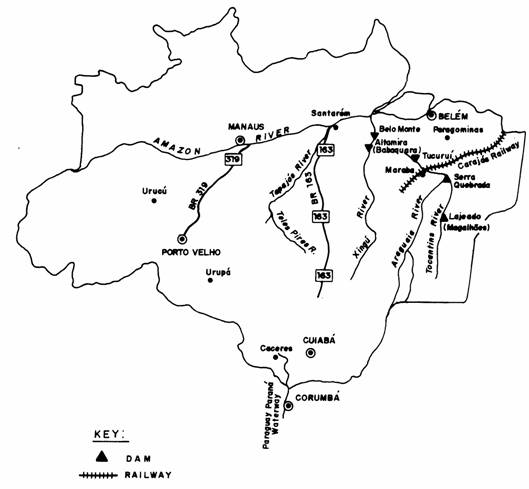
[Figure
3 here]
It
is important to understand that
[Table
3 here]
GENERIC
PROBLEMS WITH THE LICENSING PROCESS
Lobby stimulated before decision
One
problem is that powerful interest groups in favor of project construction are
mobilized before the environmental impacts are assessed. Impact assessment only occurs shortly before
actual construction begins. In the case
of Avança Brasil, the program has an English-language webpage designed to
attract international financing for the projects, obviously in advance of the
environmental studies of each project.
In April 2001, a presentation in
“Dragging
effect” of third parties
The
existence of environmental impact studies does not mean that damaging projects
would not be undertaken. The claim that if any project that involves
environmental damage, it must be reformulated or dropped (e.g.,
Brazilian Embassy, London 2001) does not fit with experience. One of the problems is that
The
BR-163 (Santarém-Cuiabá) highway provides a dramatic example of the dragging
effect. This highway opens access to
vast areas of relatively intact forest that is particularly susceptible to
degradation through fire due to the strong dry season in the area (Carvalho and
others 2001, Nepstad and others 2000).
Paving the BR-163 is a top priority under Avança Brasil, and sawmills
are already migrating to the area (Schneider and others 2000, p. 19).
Avança
Brasil proponents often suggest that the program’s infrastructure in
Tendency
for favorable reports
Consulting
firms tend to prepare reports favorable to approval of the projects, since the firms
are contracted by project proponents that have heavy financial stakes in
securing approval (e.g., Fearnside and Barbosa 1996b). The Environmental
Impact Study (EIA) and Report on Impact on the Environment (RIMA) are paid for
by the project proponent, who thereby has influence in choosing the personnel
who are hired, setting near-impossible deadlines that assure that only cursory
attention is given to problems and that the proponent reviews a series of
preliminary drafts of the reports (with opportunities to “suggest” deletions
and other changes) prior to their being submitted to government
authorities. Frequently the contracts
stipulate that the last installment of the consulting firm’s payment is only
made after the government environmental authorities have approved the report,
thereby virtually guaranteeing that the report will be drafted to emphasize the
proposed project’s positive aspects.
An
example is provided by the Araguaia-Tocantins Waterway, a top priority under
Avança Brasil. In this case, when
statements regarding heavy impacts on indigenous populations along the route
were included in the report, the outcome was to alter the report rather than to
drop the project (Carvalho 1999, Switkes 1999). The waterway was temporarily
embargoed by judicial order (Silveira 1999), but the company later obtained
another order allowing continuation of the project (Radiobrás 1999).
The Teles-Pires—Tapajós
Waterway has also been the subject of a scandal involving its environmental
impact studies, which, in this case, were divided into two separate studies,
one above and one below the Mundurucú indigenous area that is bisected by the
waterway (Novaes 1998). The project has
been barred since 1997 by a judicial order, but it continues to appear in the
smorgasborg of potential Avança Brasil investments presented to prospective
investors (e.g., Consórcio Brasiliana 2000).
Emphasis
on the existence of steps
More
common than scandals such as those surrounding the Tocantins-Araguaia and
Teles-Pires--Tapajós Waterways is the more subtle effect of the licensing
system requiring only that each step in the process be completed (report
submission, public hearing, etc.), with little regard, in practice, to the
content of the information. In effect,
the consultants writing the reports and the witnesses at the hearings can say
whatever they like, even pointing out major impacts, and the project approval
process simply moves ahead based on the fact that the reports have been duly
submitted and the population has been “consulted” (Eve and others 2000,
Fearnside and Barbosa 1996a).
Unleashing
chains of events
One
of the inherent problems of the current environmental impact assessment system
in
The
impacts of hydroelectric dams are severe in many ways that go beyond land-use
transformations (World Commission on Dams 2000). Little evidence exists that a fundamental
change in project selection has occurred, since the most damaging project of
all is now scheduled for completion in 2013, beyond the time horizon of Avança
Brasil. This is the 6000-km2
Altamira Dam, formerly called Babaquara (Brazil, ELETROBRÁS 1998). The planned Belo Monte Dam (known as
“Kararaô” prior to 1992), a top priority under Avança Brasil, is closely linked
to this much more damaging project, which would regulate the flow of the Xingu
River to compensate for the small reservoir at the Belo Monte Dam (Santos and
de Andrade 1990, Fearnside 2001b).
In
1989, an Amerindian woman threatened Antônio Muniz (director of ELETRONORTE,
the electrical power authority in
The reappearance of plans for the Babaquara Dam is indicative of a basic problem: the lack of
a legal mechanism by which the government can make irrevocable commitments not
to build specific projects that are known to be damaging. When projects are judged to be politically
unpromising due to criticisms of their expected impacts, they can simply lie
dormant for decades, only to re-emerge at a more politically favorable
moment. Such projects are known as “vampire projects.”
Another
example is provided by the Paraguay-Paraná waterway, or “Pantanal Hidrovia.” The Brazilian government announced in March 1998
that it was dropping plans for the Paraguay-Paraná Waterway (e.g.,
Associated Press 1998). Now, the Mourinhos
barge port, 80 km from
Locks
in the Luis Carlos Magalhães (Lajeado) Dam provide another example of the
danger of a piecemeal approval process.
Construction of the locks, an Avança Brasil project, would have no
conceivable purpose were the rest of the
Deforestation
inevitably leads to loss of opportunity for sustainable use of standing forest,
including tapping the value of environmental services (Fearnside 1997). Environmental services include biodiversity
(Fearnside 1999b), water cycling (Fearnside 2000b), and avoided emissions of
greenhouse gases. Carbon storage is the environmental service that is nearest
to yielding substantial monetary returns, even despite the March 2001
withdrawal of the United States from negotiations over the Kyoto Protocol and
the July 2001 Bonn Agreement ruling out credit for avoided deforestation in the Clean
Development Mechanism (CDM), defined in Article 12 of the Protocol, in the
first commitment period (2008-2012).
Use of avoided deforestation in the CDM after 2012 would require
definition of several critical points.
The same applies to possible use of similar crediting outside of the
Kyoto Protocol. How baselines would be defined remains an open
question, with important implications both for the amount of credit obtainable
and for the potential for perverse incentives (Watson and others 2000; Hardner
and others 2000). Important among these
considerations are requirements regarding certainty (Fearnside 2000c),
permanence (the time over which carbon would be kept out of the atmosphere)
(Fearnside and others 2000), and various forms of leakage (effects of the
project, such as displaced population or deforestation activity, outside of the
project’s physical or conceptual boundaries, often leading to negation of the
intended mitigation results) (Brown and others 2000, Fearnside 1999c).
In
the Brazilian context, if only historical deforestation rates are allowed as a
baseline then credit would be given to (figuratively) “fence off” remnants of
remaining forest in parts of Brazil that had already experienced heavy
deforestation by 1990, whereas avoiding the future opening of currently
untouched areas would not gain credit.
The example of Avança Brasil illustrates why it is worthwhile to find
ways to make crediting for avoided deforestation apply to new frontiers as
well. What makes Avança Brasil so
damaging to the environment, including its role as a source of carbon
emissions, is precisely that it opens vast new “virgin” areas to deforestation,
logging, and fire. The likely price of
not devising regulations that give credit for avoiding these impacts would be
the transformation of the computer-generated scenarios into reality. Clearly the stakes are high.
It
is worth noting that the CDM is not the only means by which
BENEFITS
OF EXPORT INFRASTRUCTURE
A
basic question to be answered with respect to export infrastructure, as for any
planned project, is “Are the benefits worth the cost?” Unfortunately, the benefits of export
infrastructure are meager, especially in terms of social benefits for
Aluminum
processing, which is a major beneficiary of planned hydroelectric dam
construction, provides another extreme example. Albrás, which uses power from
the grid supplied by Tucuruí and other dams, consumes more electricity than the
city of
The
Serra Quebrada Dam, to be built on the
If
power is to be used for aluminum, then there is virtually no limit to the
amount of generating capacity “needed.”
The
notion that projects such as highways and waterways will improve the plight of
the Amazonian poor is quite farfetched.
These projects are primarily designed for transporting commodities such
as soybeans, which are grown by wealthy agribusiness operations and generate
little employment (Fearnside 2001a). For
example, in Maranhão an average of 167 ha of soybeans are needed to create one
job according to a survey by EMBRAPA, the Brazilian Enterprise for Agriculture
and Ranching Research (Carvalho 1999). Soybeans are often being produced in former
savannas, and are transported on highways, waterways, and railways through the
forest areas. In the forest areas
themselves cattle ranching is the major land use that quickly dominates the
landscape in areas that have been opened to transportation. Ranching benefits a wealthy elite and
provides minimal employment (Fearnside 2001c).
In the case of logging, the employment generated is likely to be
temporary because most logging in
Much
of the infrastructure is justified by export of soybeans, a crop with minimal
social benefits (Fearnside 2001a).
Constructing a massive infrastructure network to support soybean growing
is difficult to imagine as coming under the rubric of “sustainable
development.”
IMPROVING
THE ENVIRONMENTAL LICENSING SYSTEM
Avança
Brasil offers multiple lessons for improvement of
The
studies themselves could be improved in various ways. Broadening them to include the “dragging
effect” of economic activity stimulated by the infrastructure is
essential. It is impressive that no
estimates of the deforestation impact of the proposed infrastructure were
generated either as a part of the planning process for Avança Brasil or as a
part of the environmental impact assessment process for the individual
projects. The two available studies
(Nepstad and others 2000, Laurance and others 2001a) were produced independent
of these processes and after Avança Brasil was underway.
Studies
are needed that assess the impact of interrelated sets of projects, as in river
basin development, before individual projects are approved. The Xingu Dams illustrate the danger of
unleashing chains of events that are much more damaging than the initial projects. For each project, a full suite of
alternatives needs to be analyzed—broadly interpreted to include other forms of
addressing the social objectives of the projects. The debate over the Urucu-Porto Velho gas
pipeline, mentioned earlier, makes this clear.
Guaranteeing
the objectivity of impact studies will require addressing the proponent-pays
arrangement that is specified in the regulations governing the system (CONAMA
resolution 001 of 23 January 1986).
Replacing this with public funding would not be viable, as funds would
not be available in practice in adequate amounts and with sufficient speed and
efficiency to make the system work. A
better solution would be for proponents to be required to contribute money to a
fund that would be administered independently under government oversight; the
fund would then contract out the studies without involvement of the
proponent. This would remove the biases
inherent in the proponent’s current right to select consulting firms and the
subsequent influence enjoyed by proponents over contracting within firms,
establishment of impossible deadlines and other limitations that prevent an
adequate evaluation of impacts, and review of report drafts by the proponent
prior to submission to authorities.
Public participation could be increased by better choice of locations
and times of hearings, and by efforts to facilitate the availability of
relevant project documentation. This
should always include public availability of the full Environmental Impact
Study (EIA), not just the shorter Report on Impact on the Environment
(RIMA). Availability should include
release of the full documents through the internet, as opposed to the current
form of “access” that is restricted to the opportunity to consult bound volumes
in the library of the state environmental agency.
Judicial
procedures are an important part of the licensing process. An important need is creation of a mechanism
by which commitments can be made not to implement certain projects that
are identified as especially damaging.
In the absence of such a mechanism, major problems that may be
identified in studies of interlinked projects, such as river-basin development
plans, would have little potential effect other than possible denial of
licensing for the initial project in each project set.
Involvement
of the Public Ministry is an important safeguard in assuring the inclusion of
relevant consideration in the reports and adherence to the procedures that have
been specified for the licensing system (see Table 3). This provides the main means by which
alternative written documentation can be included in the decision process.
However, this kind of judicial involvement is not a substitute for a licensing
system that works on its own. Efforts
must be made to strengthen the licensing system, while maintaining the
safeguard provided by the judiciary.
CONCLUSIONS
The
challenge presented by Avança Brasil makes clear the need to further strengthen
ACKNOWLEDGMENTS
An earlier version of this paper was presented at the Seminário
Nacional sobre o Desenvolvimento da Amazônia: Um debate sobre o Programa Avança
Brasil, Senado Federal, Brasília, 9-10 April 2001, and is expected to appear in
Portuguese in the proceedings of the seminar.
NOTES
(1) “Pristine areas” have intact primary-forest cover but
may have limited hunting, fishing, and shifting cultivation by traditional
indigenous communities. “Light-impact areas” have >95% primary-forest cover
but can experience illegal gold-mining, small-scale farming, hunting,
hand-logging, and extraction of nontimber resources such as rubber.
“Moderate-impact areas” have >85% intact primary-forest cover but contain
localized forest clearings and some roads and may be affected by logging,
mining, hunting, and oil and gas exploration. “Heavy-impact areas” have no or
little primary-forest cover and are heavily fragmented; such areas experience
edge effects, fires, and logging.
LITERATURE CITED
Associated Press. 1998. Environmentalists are skeptical
Pantanal waterway was killed. Associated
Press release
Brazil, ELETROBRÁS.
(Centrais Elétricas Brasileiras S.A.). 1998. Plano decenal 1999-2008.
ELETROBRÁS, Rio de Janeiro, Brazil.
Brazil, INPE (Instituto Nacional de Pesquisas
Espaciais). 2000. Monitoramento da Floresta Amazônica Brasileira por
Satélite/Monitoring of the Brazilian Amazon Forest by Satellite:
1998-1999. INPE: São José dos Campos,
SP, Brazil. (http://www.inpe.br).
Brazil, Ministério do Planejamento. 1999. Avança
Brasil: Plano Plurianual 2000-2003/Orçamento da União 2000. Ministério do
Planejamento, Brasília, DF, Brazil. 359 pp.
Brazil, Ministério do
Planejamento. 2002. Avança Brasil. Ministério do
Planejamento, Brasília, DF, Brazil. (http://www.abrasil.gov.br/)
Brazilian
Embassy,
Brown, S. and 17
others. 2000a. Project-based activities. Pages 283-338 in R.T. Watson,
I.R. Noble, B. Bolin, N.H. Ravindranath, D.J. Verardo, and D.J. Dokken (eds.),
Land use, land-use change and forestry: A special report of the
Intergovernmental Panel on Climate Change (IPCC).
Carvalho, G., A.C. Barros, P. Moutinho, and D.
Nepstad. 2001. Sensitive development could protect
Carvalho,
G.O., D. Nepstad, D. McGrath, M.C.V. Diaz, M. Santilli, and A.C. Barros. 2002.
Frontier expansion in the Amazon: Balancing development and sustainability. Environment
44(3): 34-45.
Carvalho, R. 1999. A
Amazônia rumo ao “ciclo da soja.”
Amazônia Papers No. 2, Programa Amazônia, Amigos da Terra, São Paulo,
Brazil. 8 pp. (http://www.amazonia.org.br).
Consórcio Brasiliana.
2000. Programa Brasil em ação: Eixos nacionais de integração e desenvolvimento.
Banco Nacional de Desenvolvimento Econômico e Social (BNDES) PBA/CN-01/97.
Relatório Final do Marco Inicial, Consórcio Brasiliana, Brasília, DF, Brazil. 3
vols.
Cotton, C., and T. Romine.
1999. Facing Destruction: A Greenpeace briefing on the timber industry in the
Brazilian Amazon. Greenpeace International,
Eve, E., F.A.
Arguelles, and P.M. Fearnside. 2000. How well does
Fearnside, P.M. 1997.
Environmental services as a strategy for sustainable development in
rural
Fearnside, P.M. 1999a.
Social Impacts of
Fearnside,
P.M. 1999b. Biodiversity as an environmental service in
Fearnside, P.M. 1999c. Forests and global warming mitigation in
Fearnside, P.M. 2000a. Código florestal: O perigo de abrir brechas. Ciência Hoje 28(163): 62-63.
Fearnside, P.M. 2000b Environmental
services as a strategy for sustainable development in rural
Fearnside, P.M. 2000c. Uncertainty
in land-use change and forestry sector mitigation options for global warming:
plantation silviculture versus avoided deforestation. Biomass and Bioenergy 18(6): 457-468.
Fearnside,
P.M. 2000d. Greenhouse gas emissions from land use change in
Fearnside,
P.M. 2001a. Soybean cultivation as a threat
to the environment in
Fearnside, P.M. 2001b.
Environmental impacts of
Fearnside,
P.M. 2001c. Land-tenure issues as factors in environmental destruction in
Brazilian Amazonia: The case of southern Pará. World Development 29 (8):
1361-1372.
Fearnside,
P.M. 2001d. The potential of
Fearnside, P.M., and R.I. Barbosa. 1996a. The Cotingo Dam as a test of
Fearnside, P.M., and R.I.
Barbosa. 1996b. Political benefits as barriers to assessment of environmental
costs in
Fearnside, P.M.,
D.A. Lashof, and P. Moura-Costa. 2000. Accounting for time in
mitigating global warming through land-use change and forestry. Mitigation and
Adaptation Strategies for Global Change 5(3): 239-270.
Hardner, J.J., P.C.
Frumhoff, and D.C. Goetz. 2000. Prospects for mitigating carbon, conserving
biodiversity, and promoting socioeconomic development through the Clean
Development Mechanism. Mitigation and Adaptation Strategies for Global
Change 5: 61-80.
International
Rivers Network, and Coalição Rios Vivos. 2001. Hidrovia news: New government smokescreen: “no more Hidrovia – just improvements for
already navigable waterway.”
International Rivers Network,
Jochnick,
C. 1995. Amazon oil offensive. Multinational Monitor 1995(1): 1-6. (http://multinationalmonitor.org/hyper/issues/1995/01/mm0195_07.html.)
Laurance, W.F., M.A.
Cochrane, S. Bergen, P.M. Fearnside, P. Delamônica, C. Barber, S.
D’Angelo, and T. Fernandes. 2001a. The Future of the Brazilian Amazon. Science
291: 438-439.
Laurance,
W.F., M.A. Cochrane, S. Bergen, P.M. Fearnside, P.
Delamônica, C. Barber, S. D’Angelo, and T. Fernandes. 2001b. The Future of the
Brazilian Amazon: Supplementary Material. Science Online (http://www.sciencemag.org/cgi/content/full/291/5503/438/DC1).
Laurance,
W.F., M.A. Cochrane, P.M. Fearnside,
Nepstad, D., J.P. Capobianco, A.C. Barros, G.
Carvalho, P. Moutinho, U. Lopes, and P. Lefebvre. 2000. Avança Brasil: Os
Custos Ambientais para Amazônia. Instituto de Pesquisa Ambiental da Amazônia
(IPAM), Belém, Brazil. 24 pp.
(http://www.ipam.org.br/avanca/politicas.htm).
Nepstad, D., G. Carvalho, A.C. Barros, A.
Alencar, J.P. Capobianco, J. Bishop, P. Moutinho, P. Lefebvre, U.L. Silva, Jr.,
and E. Prins. 2001. Road paving, fire regime feedbacks, and the
future of Amazon forests.
Novaes, W. 1998. Corda em
casa de enforcado. O Estado de São Paulo 7 August 1998.
Radiobrás. 1999.
http://www.radiobras.gov.br/processados/NAC-19990930-164618-0160.htm.
Santos, L.A.O., and L.M.M. de Andrade (eds.). 1990. Hydroelectric dams on
Schneider, R.R., E.
Arima, A. Veríssimo, P. Barreto, and C. Souza Junior. 2000. Amazônia
sustentável: limitantes e oportunidades para o desenvolvimento rural. World
Bank, Brasília and IMAZON, Belém,
Silveira, J.P. 2001. Development of the Brazilian
Amazon. Science 292: 1651-1652.
Silveira, W. 1999. ‘Juiz
suspende licenciamento de hidrovia’. Folha de São Paulo, 23 September
1999, p. 1-7.
Switkes, G. 1999. Gouging out the heart of a river:
Channelization project would destroy Brazilian rivers for cheap soybeans. World
Rivers Review 14(3): 6-7.
Themag. 2000.
Aproveitamento hidrelétrico Serra Quebrada: Estudo de impacto ambiental: Volume IV. Diagnóstico do meio sócio-econômico tomo 1/2 – texto. Themag No. 6291-03-GL-830-RT-00048-R0.
Themag Engenharia e Gerenciamento, Ltda., São Paulo, SP, Brazil. Irreg.
pagination.
Watson, R.T., I.R. Noble, B.
Bolin, N.H. Ravindranath, D.J. Verardo, and D.J. Dokken (eds.) 2000. Land use,
land-use change and forestry: A special report of the Intergovernmental Panel
on Climate Change (IPCC).
World Commission on Dams.
2000. Dams and development: A new framework for decision-making. Earthscan,
FIGURE
LEGENDS
Figure 1 –
Figure 2 – Major Avança
Brasil projects.
Figure
3 – Locations mentioned in the text.
Table 1: Selected Avança Brasil infrastructure project types in the Legal Amazon region(a)
Project type Number Length or size Cost
(US$ million)
Highway paving 30 7,560 km 2,794
Highway segment upgrading 3 46
Agricultural road upgrading 6 1,023 km 290
Railways 4 1,625 km 1,749
Gas pipelines 2 920 km 450
Industrial waterways 2 1,057 km 55
Locks in hydroelectric dams 2 254
Hydroelectric dams 10 20.4 MW 11,942
Transmission lines 12 4,830 km 651
----------------------------------------------------------------------------------------------------------
(a)
Information from Consórcio Brasiliana (2000).
Table 2: Comparison of modeling assumptions and results of GIS studies of infrastructure in Brazilian Amazonia
Laurance and Nepstad and
others 2001a,b others 2000, 2001
ASSUMPTIONS
Width of buffer for deforestation 50 km 50 km
Width of buffer for degradation 200 km Not considered
Impacts considered Roads, railways, Roads only
pipelines,
transmission lines,
waterways, dams
Base for deforestation in buffers All existing PA-150, BR-010,
highways BR-364
Effect of protected areas Inhibit Not considered
deforestation and
degradation depending
on type and distance
RESULTS
Deforestation rate 269-506 400-1350
(103 ha/year additional)
Degradation 1.53-2.37 Not considered
(106 ha/year additional)
Greenhouse gas emission 52.2-98.2 200-550
from additional deforestation
(106 t C/year)
Table 3:
Legal basis National Council of the Environment
(CONAMA) resolution 001 of 23 January
1986
Reports required EIA (Environmental Impact Study)
for major projects RIMA (Report on Impacts on the Environment)
Report preparation A “multidisciplinary team” that is “not directly
or indirectly dependent on the project
proponent” (normally a consultancy firm)
Payment for reports Project proponent
Public access RIMA: publicly available at the state
environmental agency (OEMA) in the state
where the project is located
EIA: differing interpretations; in practice the
report is usually not available
Report approval Council
of the Environment (Conselho do
Meio Ambiente)(a) if project is wholly located
in a single state; Brazilian Institute for the
Environment and Renewable Natural
Resources (IBAMA) if the project spans more
than one state. Operating license issued by OEMA.
Alternatives considered EIA and RIMA must consider “alternatives”.
This is interpreted by NGOs to mean
alternatives to achieve the project’s social
objectives, whereas project proponents
interpret this to mean alternative means of
exploiting the resource in question.(b) Judicial
interpretation is pending.
Public consultation Required for presentation of the RIMA in a location (or locations) “accessible to interested parties”.(c) Hearings are organized by the OEMA with participation of the Public Ministry.
Judicial participation The “Public Ministry” (Ministério Público)(d)
is an independent branch of the judiciary that
has considerable autonomy in initiating
inquiries, soliciting information and deciding
cases (see Eve and others 2000). Requests by the
Public Ministry for addition of information to
the RIMA, usually at the time of the public
hearings, are an important hurdle in the
approval process.
-------------------------------------------------------------------------------------------------------
(a) The “Council of the Environment” in each state is appointed by the state government. These councils are often dominated by local business interests that are favorable to infrastructure projects (see Carvalho and others 2002).
(b) For example, alternatives to the Urucú –
(c) CONAMA resolution 009 of
(d) Authorized by Law No 7347 of
Fig 1
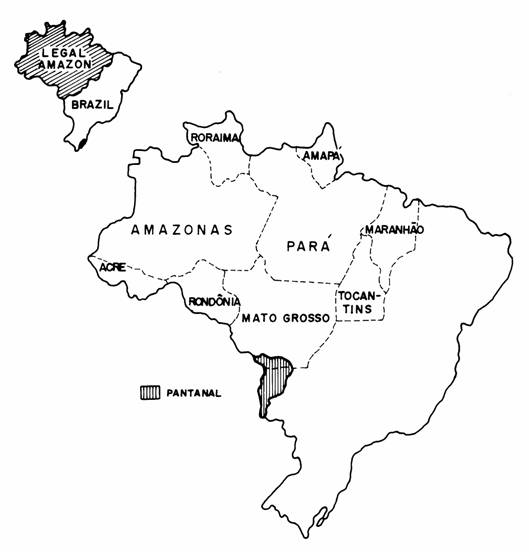
Fig.
2
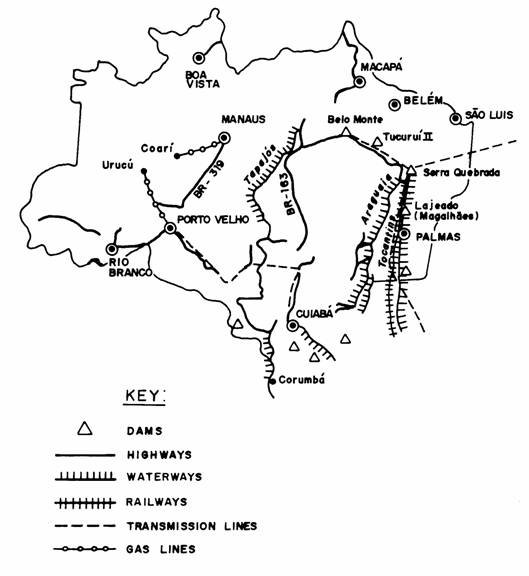
Fig. 3